What is an ePAG advocate?
ePAGs stands for European Patient Advocacy Groups. They are non-profit organisation that represents patients of a given rare diseases at the EU-level. They were launched by EURORDIS specifically to integrate ERNs. Hence in 2016, Eurordis and the European rare disease community established the first 24 ePAGs, aligned to the clinical scope of each ERN. Today, the ERNs community counts over 300 ePAGs.
The role of an ePAG is to represent the voice and interests of their patient community within an ERN, in other words to act as the bridge between their community and an ERN’s management team and network of clinicians and researchers. They are thus members of all their ERN’s gorvenance bodies : Board Committee, Executive Committee, and each of every Workgroups. ERNs being fundamentally patient–centred network, ePAGs are crucial to our networ. Their role is to make sure that the patients’ voice and perspectives are taken into account when designing and executing new rare diseases projects.
To lean more about ePAGs and what they do, you can consult this EURORDIS webpage.
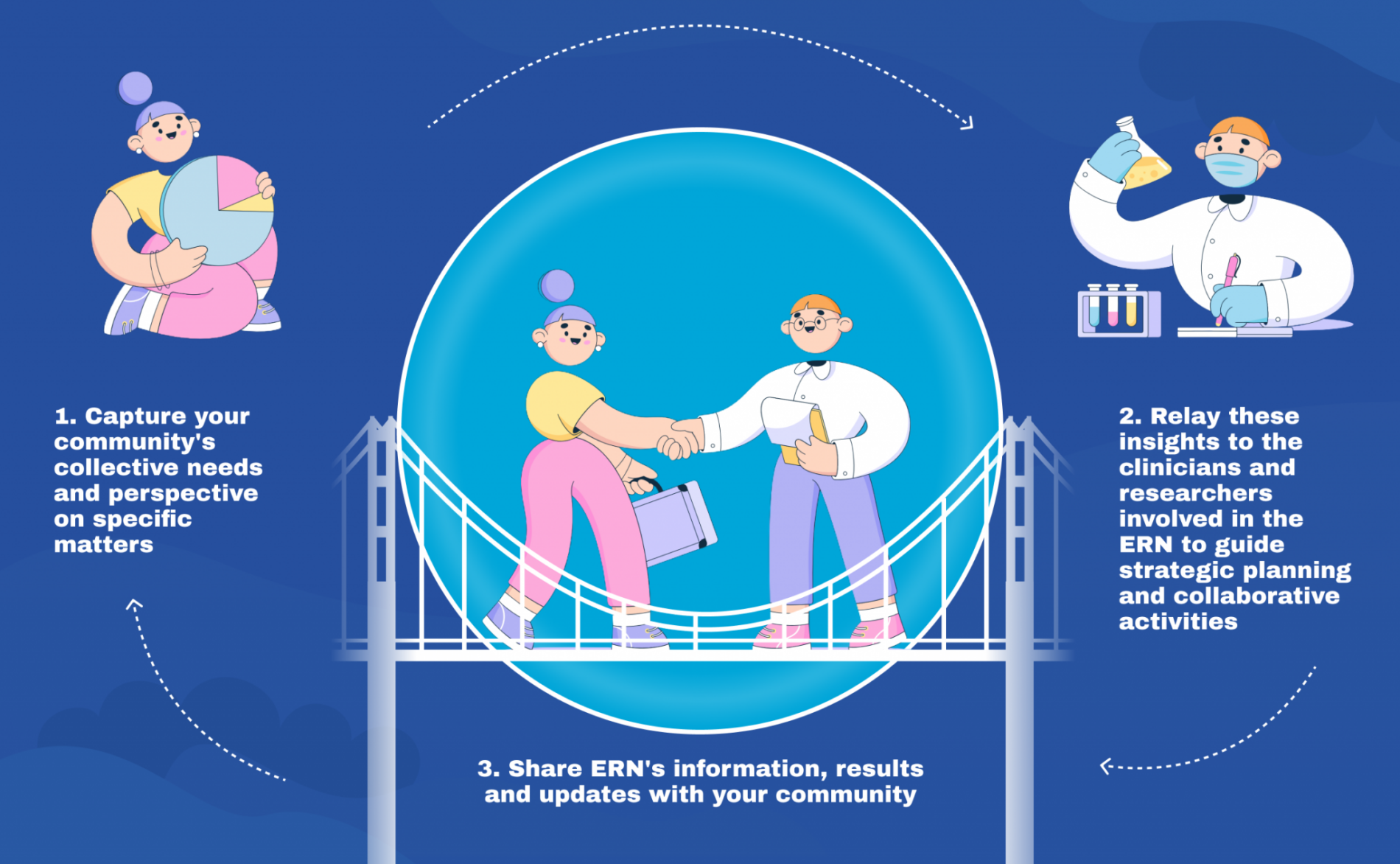
ePAGs’ functions in an ERN – EURORDIS infography
Information about cross-border healthcare.
All citizens of the European Union have the right to cross-border healthcare. In other word you can chose to get your healhtcare in another European country than the one you live in.
Considering the scattered nature of knowledge and ressources in rare diseases care, patients knowing their rights at the EU level is fundamental. You can check out the below document to get on point on your cross-border rights and ressources as a European patient:
How and why to become an ePAG advocate?
Becoming an ePAG is open to all rare disease patient organisations (wether EURORDIS members or non-members based in the European Union).
Recruitments of ePAGS are organised twice every year (in February-March and July-September), to ensure that patients are fully represented within the networks’ different projects and governance bodies. 47 ePAG members have been endorsed so far.
Becoming an ERN ePAG means being part of a broader community of patients associations that share your questions and struggles, and that you can become stronger with. You’re also joining a vast network of researchers and clinicians that are experts in rare malformative or neurodevelopmental diseases, with whom you can exchange ideas and perspectives to brainstorm new projects and launch new initiatives to improve the life of those living with a rare disease. To understand what joining our ITHACA community means, you can have a look at our special brochure.
You can also consult EURORDIS’ guide on patients-partnership in rare disease research or their more general flyer on ePAG’s ERN involvment.
Hear also from our Patient Board co-chair Dorica Dan on why she became an ePAG and joined the ITHACA network:
If you are a patient association in the field of ITHACA and are interested in joining the network, you can contact Anne Hugon at anne.hugon@aphp.fr.
The ERN-ITHACA Patient Advisory Board & Steering Committee
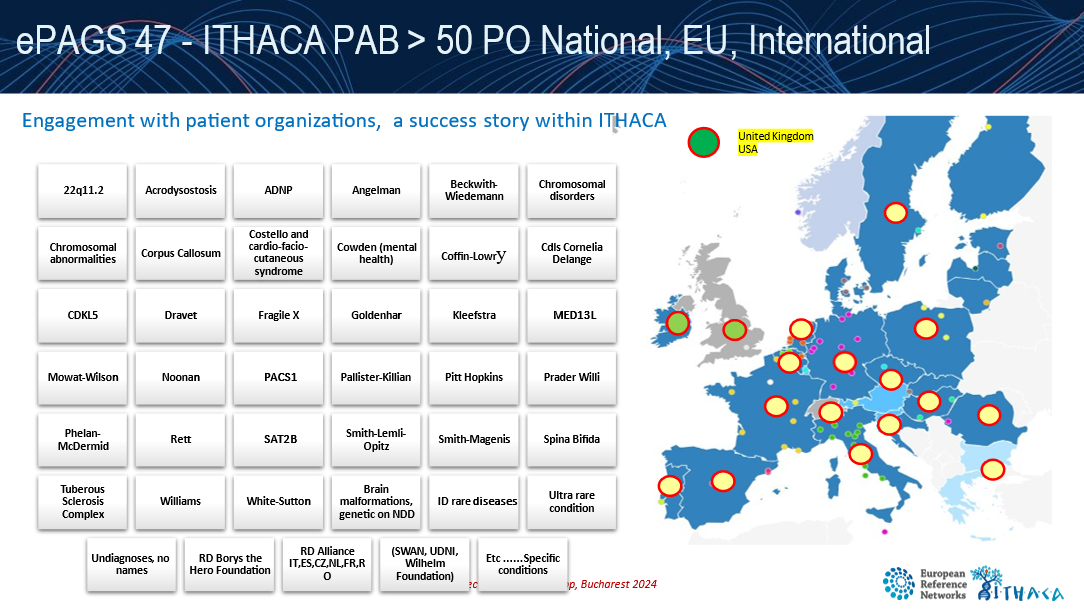
The ERN-ITHACA Patient Advisory Board is the official name for our ePAGs community. At this date, it consists of 47 patient associations, each representing a specific rare disorder:
The ERN-ITHACA Steering Committee (SC) is the governing body elected by the Patient Advisory Board. It consists in a chair, a co-chair, and three other members. It is part and parcel of ERN-ITHACA’s governance and thus participates in each Workgroup or transversal activities and is represented in both the Executive Committee and the Board. Through this organisation, ITHACA aims to maintain a high degree of cooperation between ePAGs and other ERN stakeholders at all levels of decision making and to ensure that all the ERN activities include patients and their families.
To understand with more details how the PAB and SC work, you can read their Terms of Reference HERE.
Our members can have a look at the EURORDIS guide for ERN Patient Advocates HERE.
Our members
Steering Committee
- Chair: Dorica Dan, Romania
Romanian Prader Willi Association
- Co-chair: Tanja Zdolšek Draksler, Slovenia
IDefine Europe (Kleefstra Syndrome)
- Rui Barbosa Guedes, Portugal
APMP Associçao
- Sue Routledge, United Kingdom
Pitt Hopkins
- Daniele Palumbo, Italy
CHAMP1 Foundation, EU
- Zhana Chokheli, Georgia
RDD Alliance
- Sergios Dmitriev, Greece
Angelman, Rett Syndrome